Bathroom Exhaust Fan Installation in Ohio: What Homeowners Need to Know
A bathroom exhaust fan is one of the least expensive pieces of moisture control in your house. It is also the one most Ohio homeowners ignore until the paint starts peeling. Bathroom exhaust fan installation matters more once heating season begins. Warm shower air hits cold winter surfaces, and a small humidity problem turns into mold, rusted hinges, and a stained ceiling.
We handle bathroom fan installation across Columbus and Central Ohio, and we install bathroom fans in older homes most weeks of the year.
Here is how bathroom ventilation works, what Ohio code requires, and what we do on an installation.
Why Ohio Bathrooms Need Real Exhaust Ventilation
Ohio weather patterns cause two different bathroom problems throughout the year. In summer the outdoor air is already humid, so a bathroom without working exhaust struggles to dry out. In winter your attic and exterior walls are cold. Every shower pushes moist air toward a surface cold enough to condense it.
That moisture does slow, expensive damage. Paint and caulk fail first, then you get mildew in the grout, swollen trim, and soft drywall around the shower. In bad cases mold grows on attic sheathing right above the bathroom. An exhaust fan that moves the right amount of air out of the house prevents that for a fraction of what the repairs cost.
Comfort matters too. A quiet, correctly sized fan clears steam in a few minutes and pulls odors outside instead of into the hallway.
Signs Your Bathroom Exhaust Fan Is Not Doing Its Job
You do not need a meter to spot a failing fan. Watch for these:
- The mirror stays fogged more than five minutes after a shower.
- The fan is loud enough that nobody in the house turns it on.
- A sheet of toilet paper held to the grille does not stick while the fan runs.
- Mildew spots show up on the ceiling, near the shower, or in the corners.
- Paint peels or the drywall feels soft near the tub.
- The bathroom has no exhaust fan at all, only a window.
- You hear the fan blowing air around inside the attic.
Any two of those together mean the bathroom holds moisture. Older central Ohio homes are the usual suspects. Builders in the 1950s and 60s often relied on an operable window instead of mechanical exhaust, and a window does nothing in February.
How We Size a Bathroom Exhaust Fan
Fan capacity is measured in cubic feet per minute, or CFM. Undersized units are the most common problem we find. Usually it is a builder-grade fan rated for a powder room, installed in a full bathroom with a tub.
For a bathroom under 100 square feet, the standard industry sizing rule is 1 CFM per square foot. Ohio code sets 50 CFM as the floor for intermittent bathroom exhaust. A 60 square foot bathroom needs at least 50 to 60 CFM. Larger bathrooms get sized by fixture, with capacity added for the toilet, the tub, and the shower separately. A jetted tub or a steam shower needs more than a standard shower does. Ceiling height counts as well, since a vaulted bathroom holds more air than the floor area suggests.
Noise is the other number worth checking. Fan noise levels are rated in sones. A quieter fan gets used more often than a loud one. Anything at 1.0 sone or below reads as background noise. Cheap units in the 3 to 4 sone range tend to cause people to leave the switch off and crack a window instead. When we quote a fan, we will tell you its CFM and sone rating before installation day.
Where the Air Goes: Exhaust Venting and Ohio Code
This is where most existing installations fail. A fan only helps if the duct carries moist air completely out of the building. We regularly open ceilings and find exhaust dumping into the attic, disconnected at a joint, or crushed flat under insulation. The fan sounds fine. The moisture stays in the house, and the installation fails at the one job it had.
The Residential Code of Ohio requires bathroom exhaust to terminate outdoors, not into an attic, soffit cavity, or crawl space. Mechanical ventilation is required where there is no operable window, and intermittent bathroom exhaust is set at 50 CFM. Past the code minimum, a duct run should be short and as straight as we can make it. It also needs insulation where it crosses unconditioned attic space, or warm air condenses inside the pipe and drips back down. Smooth metal duct moves air better than flex, and the exterior termination needs a hood with a damper that closes when the fan is off.
We keep the duct off the roof deck and away from soffit vents. Venting into a soffit lets the same wet air get pulled back into the attic through nearby intake vents.

Wiring, Switches, and Controls
Fan wiring is something homeowners should leave alone. Bathrooms have their own rules in the National Electrical Code, including GFCI protection for receptacles and limits on what can share a circuit. A fan and light combination unit often needs two switch legs. Older bathrooms usually have one switch and a two-wire cable in the wall, so the wiring has to change before a new unit works the way you want.
Controls make a real difference:
- A timer switch that runs the exhaust fan 20 to 30 minutes after you leave, which is when most of the drying happens.
- A humidity sensing switch that starts the fan on its own and shuts it off once the room dries.
- Separate switches for fan and light, so the exhaust can run without the light on.
- A combination fan, light, and heater unit, which draws more current and often needs a dedicated circuit.
If your panel is already full, or you want a heater unit, we check panel capacity first. We also handle panel upgrades, so one visit can tell you whether your existing service will support the upgrade.
Our Bathroom Exhaust Fan Installation Process
Step 1. We look at the bathroom and the attic: square footage, existing duct path, joist spacing, and how the wiring runs through the ceiling.
Step 2. We size the unit, then pick a roof or sidewall termination that gives the shortest, straightest duct run for the new fan.
Step 3. We pull permits where the work requires them. Franklin County and the surrounding jurisdictions each handle this differently, and we deal with the inspection.
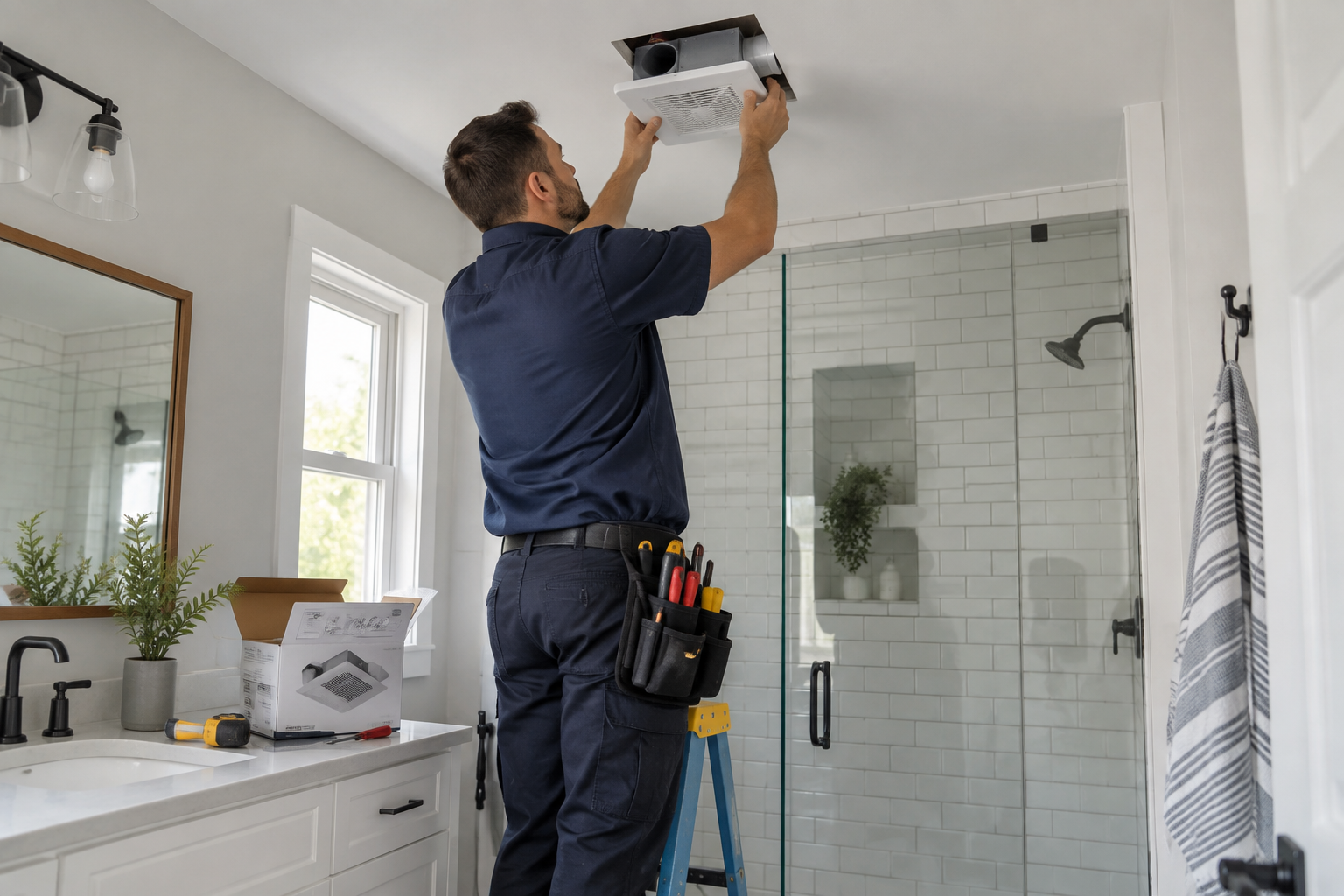
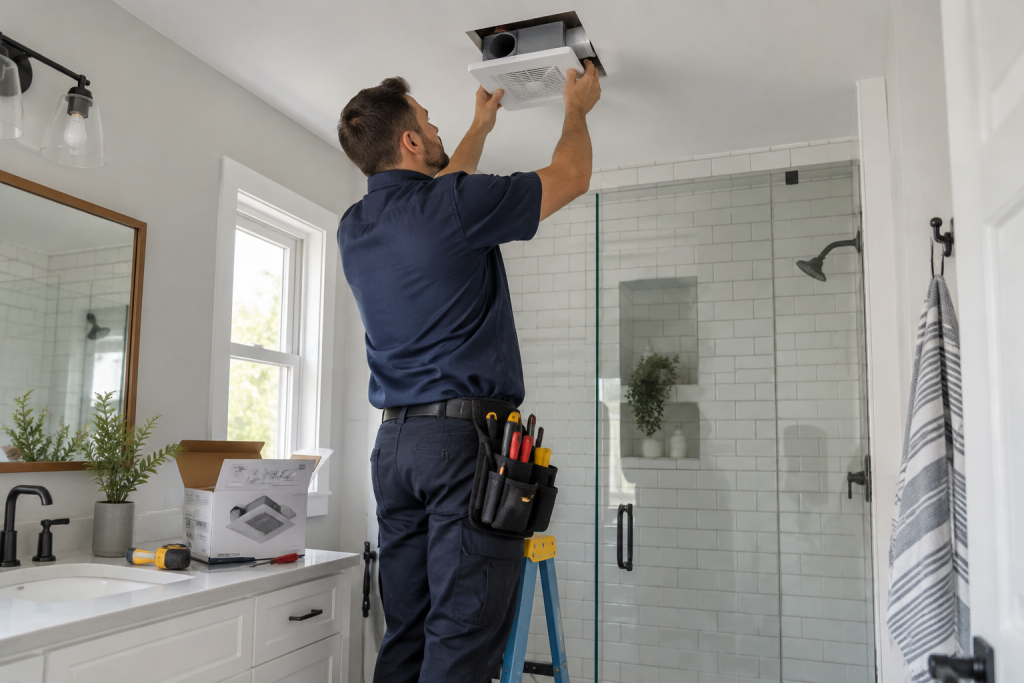
Step 4. We cut the opening and mount the housing to framing rather than to drywall, because a fan screwed to a ceiling panel rattles and sags. Wiring and duct connect through that same hole.
Step 5. We run insulated metal duct to an exterior hood with a working backdraft damper, and we seal every joint.
Step 6. We wire the unit and the controls, replacing switch cable where a timer or a separate light circuit needs it.
Step 7. We test it: airflow at the grille, damper movement outside, and every switch position before we clean up.
A licensed electrician does every installation. Griggs Electric holds Ohio License 30264 and works out of 1588 Clara St in Columbus.
Why Central Ohio Homeowners Call Us
We are local, licensed, and in houses like yours every week. Columbus neighborhoods run from 1920s bungalows to new builds in Dublin and Pickerington, and the right approach depends on the house. A tight attic in an older home gets handled differently than a two year old build with open trusses.
We tell you what the bathroom needs, not what is easiest to install. If the fan is fine and the duct is the problem, we say so. If a fan, light, and heater share one worn out circuit, we show you the panel before we sell you anything. Then we clean up. You can see the rest of our work on our electrical repairs page.
Frequently Asked Questions
How long does a bathroom exhaust fan installation take?
A straight replacement in the same location, using an existing duct that checks out, usually takes a few hours. A brand new fan in a bathroom without one takes longer, since we cut in the housing, run duct to the exterior, and add wiring for the switch.
Can I vent a bathroom fan into the attic?
No. The Residential Code of Ohio requires the exhaust to terminate outside the building. Venting into an attic puts shower moisture on your roof sheathing and insulation, which is how mold and rot start.
What size bathroom fan do I need?
For bathrooms under 100 square feet, plan on 1 CFM per square foot, with 50 CFM as the minimum. Bigger bathrooms, jetted tubs, and steam showers get sized fixture by fixture. We measure before recommending a unit.
How long should the fan run after a shower?
About 20 to 30 minutes. That is why we recommend a timer or a humidity sensing control, since few people leave a manual switch on that long.
Do I need a permit for a bathroom fan?
It depends on the jurisdiction and the scope. Adding a circuit or new wiring typically requires an electrical permit. We pull what the local building department requires and handle the inspection.
Is an exhaust fan required if my bathroom has a window?
Ohio code allows an operable window as ventilation in some cases. A window is not usable through an Ohio winter, so any bathroom that holds moisture should have a fan regardless of the minimum.
Can you replace a fan without cutting the ceiling?
Sometimes. Several manufacturers make retrofit units that mount into an existing housing. We check the housing size and duct condition first. If the housing is undersized or the duct is bad, cutting in is the honest answer.
Ready to stop wiping down a foggy mirror? Call us at (614) 837-1688 or get in touch to schedule your installation. You get quiet ventilation, code compliant venting, and protection for the paint, drywall, and framing you already paid for.